Predictive Analytics Dashboard for Sales
Increasing sales team efficiency with real-time data insights
Key Result 1
25% increase in sales pipeline accuracy
Key Result 2
30% reduction in manual reporting time
Key Result 3
15% boost in quarterly sales revenue
Project Context
Industry
Retail & E-commerce
Problem Domain
Sales & Revenue Operations
My Contribution
Analytics Strategy, Dashboard Design, User Research
Technologies & Skills
Overview
The sales team needed better insights into their pipeline and customer data. I led the development of a predictive analytics dashboard that provided real-time insights and forecasts, enabling the team to make data-driven decisions.
The Challenge
Sales forecasting was manual and error-prone, leading to missed opportunities and inefficient resource allocation. The team needed a centralized platform for actionable insights.
My Approach
- 1
Interviewed sales stakeholders to gather requirements
- 2
Partnered with data engineering to build ETL pipelines
- 3
Designed intuitive dashboard UI with real-time updates
- 4
Integrated predictive models for lead scoring and forecasting
- 5
Conducted training sessions for the sales team
The Solution
We built a dashboard that consolidated sales data from multiple sources, visualized key metrics, and provided predictive insights using ML models. The dashboard enabled the sales team to prioritize leads, forecast revenue, and identify trends.
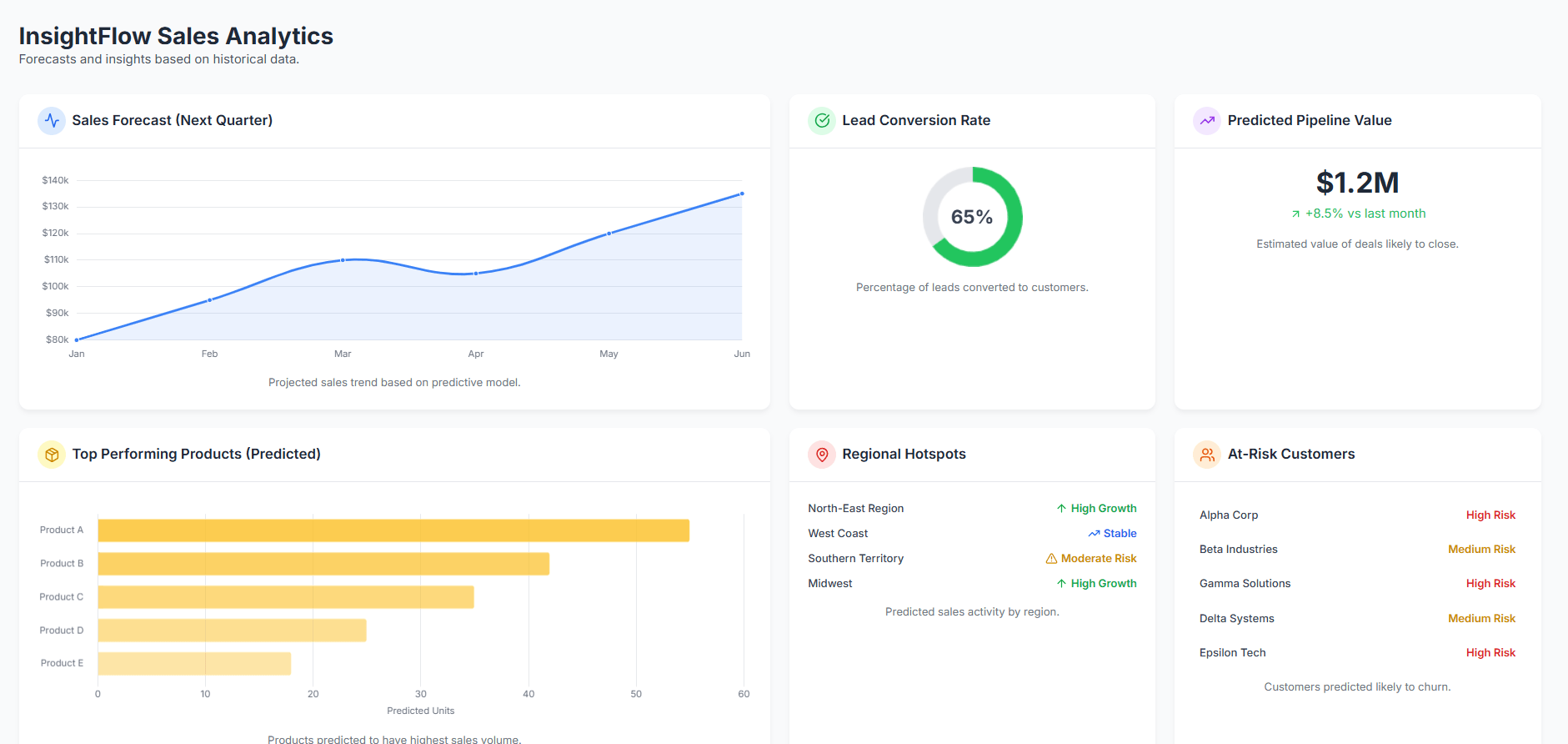
Real-time sales analytics and lead scoring in the dashboard
Results & Impact
25% increase in sales pipeline accuracy
30% reduction in manual reporting time
15% boost in quarterly sales revenue
Significant improvement in team productivity
"The dashboard has become an indispensable tool for our team. We can now focus on selling instead of reporting."
VP of Sales
Global Retail Company
Key Learnings
Implementing this predictive sales analytics dashboard taught us several critical lessons: First, user-centered design principles were essential - sales teams needed intuitive visualizations rather than complex data tables. Second, we discovered that predictive models should be transparent, with confidence levels clearly displayed to build user trust. Third, we found that combining historical data with real-time signals provided the most accurate forecasts. Finally, the project reinforced that effective training and change management were just as important as the technical solution itself for driving adoption.